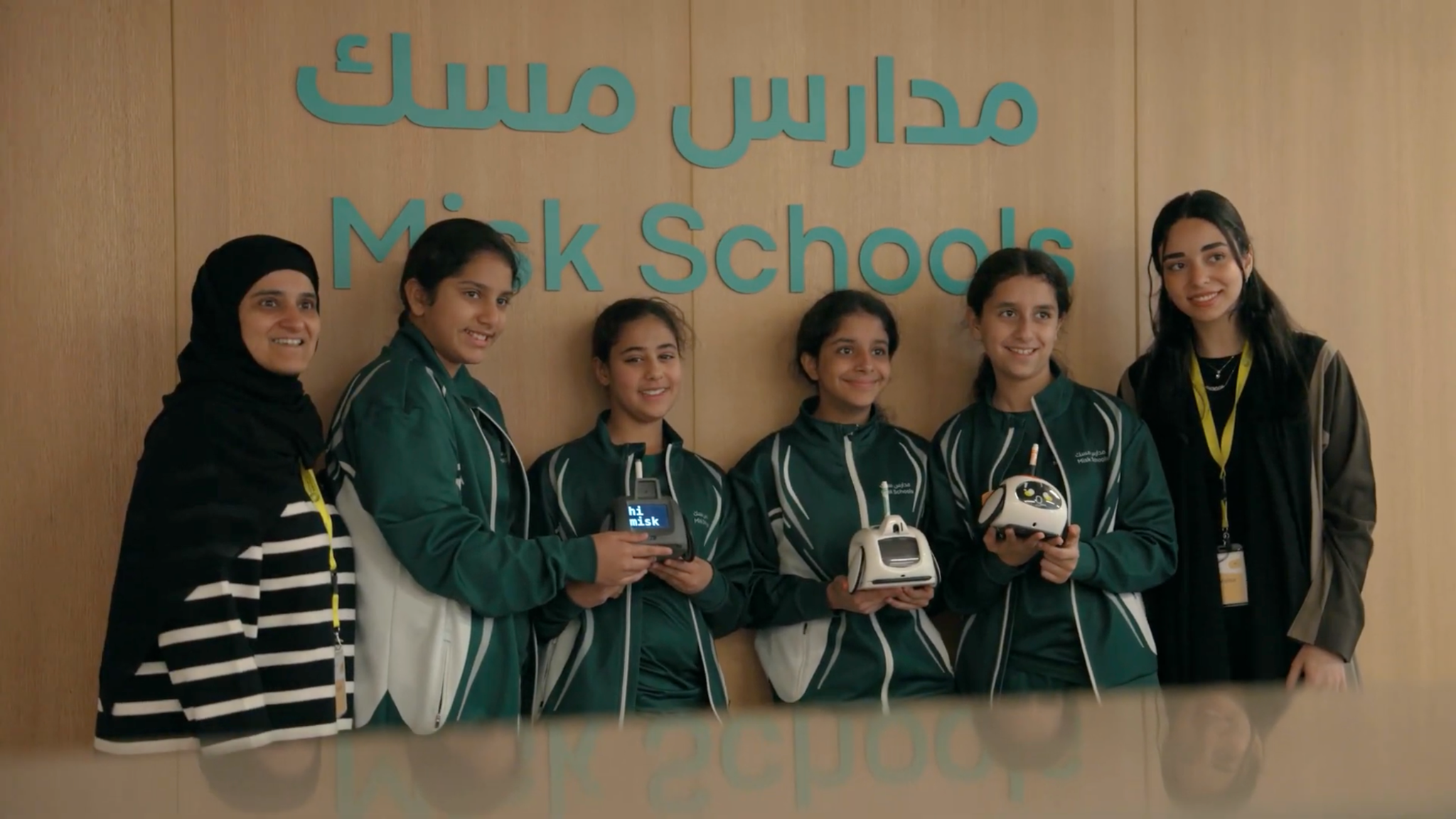
Saudi Arabia’s first school-level collaboration with the MIT Media Lab, introducing students to Doodlebot, the mobile robot that offers a platform for AI education
As part of its focus on AI and robotics education, Misk Schools welcomed Dr Sharifa Alghowinem, a Saudi research scientist from the Massachusetts Institute of Technology (MIT), to lead robotics workshops that introduce students to active AI research shaped by Saudi expertise.
Dr Sharifa is widely recognised for her work on human-robot interaction, particularly in developing robots capable of interpreting emotional cues in both Arabic and English. Her path – from early education in Saudi Arabia to a research career at MIT’s Personal Robots Group – represents a significant contribution to an area of global importance, offering an inspiring model for young Saudi learners.
Across three sessions held at the school’s Misk City campus, Dr Sharifa and her team member, Tasneem Burgleh, worked with small groups from the Junior and Upper Primary Schools. Juniors experimented with basic shapes and block coding, while Upper Primary students tackled more advanced robotic drawing tasks. The intimate format ensured each student benefited from direct guidance, while gaining insight into active research at MIT.
Commenting on the visit, Dr Steffen Sommer, Misk Schools’ Director General said: ‘Dr Sharifa’s work is important not only because it is technically advanced, but because it is rooted in a Saudi perspective shaping global research from within MIT. Her visit gave our students something rare: direct contact with a scientist who is expanding what human-robot interaction can look like in Arabic as well as English. We are proud to connect our learners with voices shaping the future of the field.’
Dr Sharifa’s background spans multimodal AI, behaviour modelling, and mental-health-related applications of robotics. After graduating from King Saud University, she earned an MSc in Software Engineering from the University of Canberra and completed a PhD in multimodal AI at the Australian National University. Her current research in Boston explores how robots use speech, gaze and movement to interpret human mood and behaviour.
She is part of the MIT research team that designed Doodlebot, a social, mobile robot built for long-term use teaching AI in K-12 classrooms. Using intuitive block-based programming, students can teach Doodlebot to recognise faces and objects, apply these models to guide its behaviour, and even shape how it draws, dances or expresses emotions. By blending artistic expression with STEM learning, Doodlebot fosters a stronger emotional connection between children and the technology they create, enabling them to build not only technical skills but also their own robot ‘personalities’.
Reflecting on this approach to hands-on learning, Dr Sharifa said: ‘Learning by Doing is the core MIT philosophy that Doodlebot embodies, making education not only fun and engaging, but also tangible, so every learning experience becomes meaningful, memorable, and impactful for students.’
Her visit forms part of a wider programme at Misk Schools designed to support a generation of students able to use, critique, and ultimately shape advanced technologies. This school focuses its provision across three strands:
1. Robotics and AI Competitions
Misk Schools continues to achieve strong results in international competitions, including the World Robot Olympiad (WRO) and the World Artificial Intelligence Competition for Youth (WAICY). Highlights include:
These achievements reflect a commitment to embedding AI literacy, a structured coaching environment and the success of a strong collaboration with Tuwaiq Academy.
2. Professional Teacher Training in AI
The school has a comprehensive AI training pathway for teachers, delivered through its on-site professional development centre, the Misk Schools Academy. Courses cover fundamentals of AI, responsible use, safeguarding, prompt writing for classroom practice, and the detection and assessment of AI-supported student work, and include MIT RAISE and Day of AI teacher training programmes. This ensures that staff are equipped with the knowledge required to guide students confidently and safely.
3. Experiential Innovation Experiences
Students benefit from direct exposure to global innovation ecosystems. In 2025, a Summer Silicon Valley programme was delivered in partnership with Stanford University to introduce students to the emerging field of Symbiotics, which explores how humans and machines interact. Visits to Apple Park, Googleplex and Lucasfilm encouraged students to engage with technologies critically, applying new tools while remaining accountable for their thinking.
The school’s December 2025 China Innovation Trip to Shanghai and Hangzhou further expanded this exposure, with visits to SenseTime, Alibaba, CATL and BrainCo, offering students insight into real-world robotics and AI deployment at industrial scale.
.png)
